
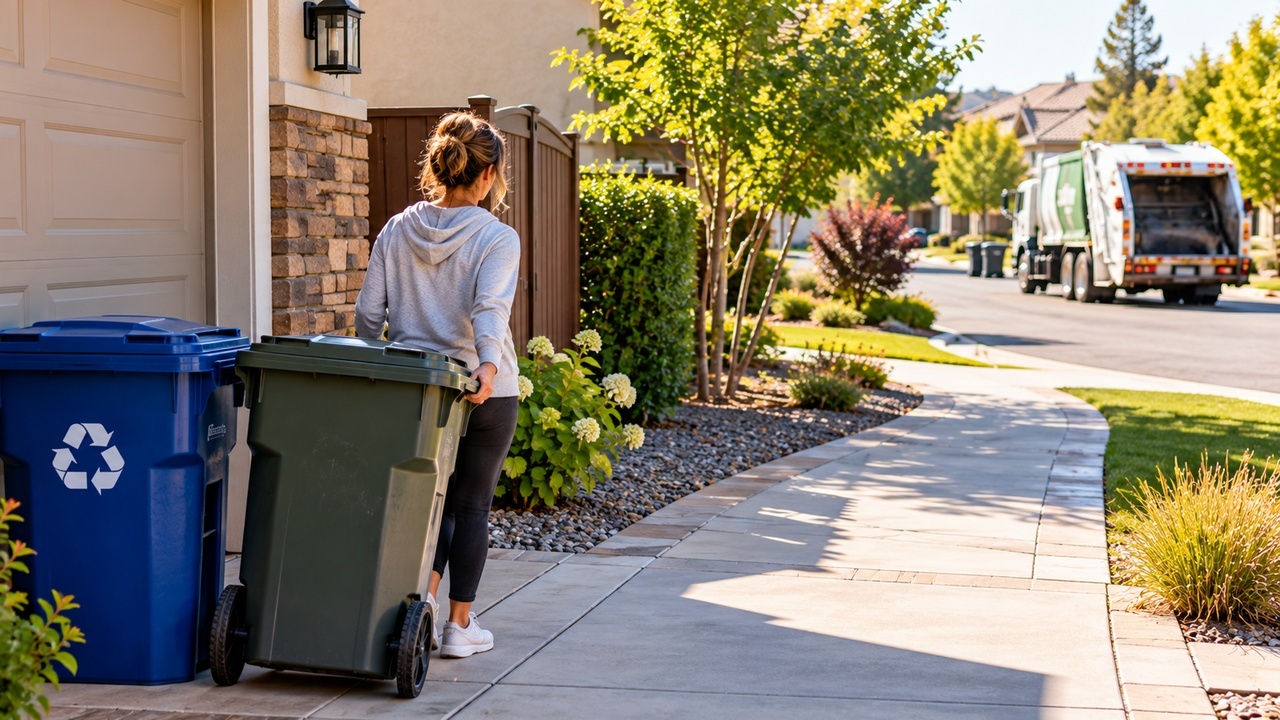
 Taking out the trash is probably not on your homebuying checklist. Yet it is one of those ordinary chores you may repeat hundreds of times after moving in. During a showing, take a moment to figure out where outdoor trash and recycling containers would be stored and how they would get from that location to the collection point.
Find the Storage Spot
Start by identifying where the containers would realistically live.
Some homes have an obvious space beside the garage. Others may require containers to be stored behind a gate, inside the garage, along a narrow side yard, or somewhere less convenient.
If you cannot immediately determine where they belong, ask yourself where you would actually want them. Consider appearance, accessibility, and how close that location is to doors, windows, vehicles, and outdoor living areas.
Walk the Route
Now trace the path from the storage location to the street or designated collection area. Is the route flat and paved? Or would you be pulling containers over gravel, landscaping, slopes, steps, tight corners, or uneven surfaces?
A long driveway can also make what seems like a minor chore considerably more involved.
Check the Gates
Side gates deserve special attention. Open them if appropriate and look at their width, direction of swing, and surrounding surfaces.
A container may technically fit through an opening but still be awkward to maneuver around an air-conditioning unit, landscaping, parked vehicle, or another obstacle.
Think About Bad Weather and Full Containers
Perform the test mentally under less-than-perfect conditions.
Imagine moving a completely full container when it is dark, raining, extremely hot, or windy.
Would the route still feel reasonable?
This detail may matter even more for someone with mobility limitations or anyone who expects children or an older household member to handle the chore.
Buyers naturally spend their limited showing time evaluating kitchens, bedrooms, bathrooms, and backyards. Those spaces deserve attention. But homeownership is also made up of repetitive little tasks.
Finding the trash-can route may not influence your entire purchasing decision, but it can reveal whether another small piece of the home’s design makes everyday life easier or unnecessarily inconvenient.
Sometimes understanding a house means following the path of the least glamorous things you will do there.
